How Is Your Hospitality Fabric Actually Fire Retardant?
Not all flame retardant fabrics perform the same over time. Before specifying hospitality textiles, understanding the difference between Real FR vs Finishing FR can significantly affect durability, maintenance performance and long-term technical transparency.
How Is Your Hospitality Fabric Actually Fire Retardant?
A short technical story explaining the difference between Real Flame Retardant (Fiber-Level FR) and Finishing / Post-Treatment FR textiles used in hospitality environments.
Flame Retardant (FR) Textiles
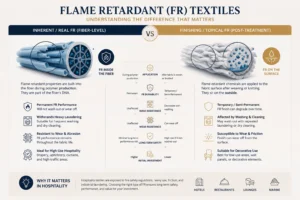
Real FR vs Finishing FR is one of the most misunderstood topics in hospitality textiles. While both methods may meet fire safety requirements, their durability, washing performance and long-term behaviour can differ significantly. In commercial hospitality environments, understanding this distinction is critical when specifying upholstery, drapery and contract textile solutions.
Hospitality fabrics are expected to withstand intensive daily use, cleaning cycles and strict safety expectations. Because of this, selecting the correct flame retardant system is not simply about compliance — it is also about long-term technical performance.
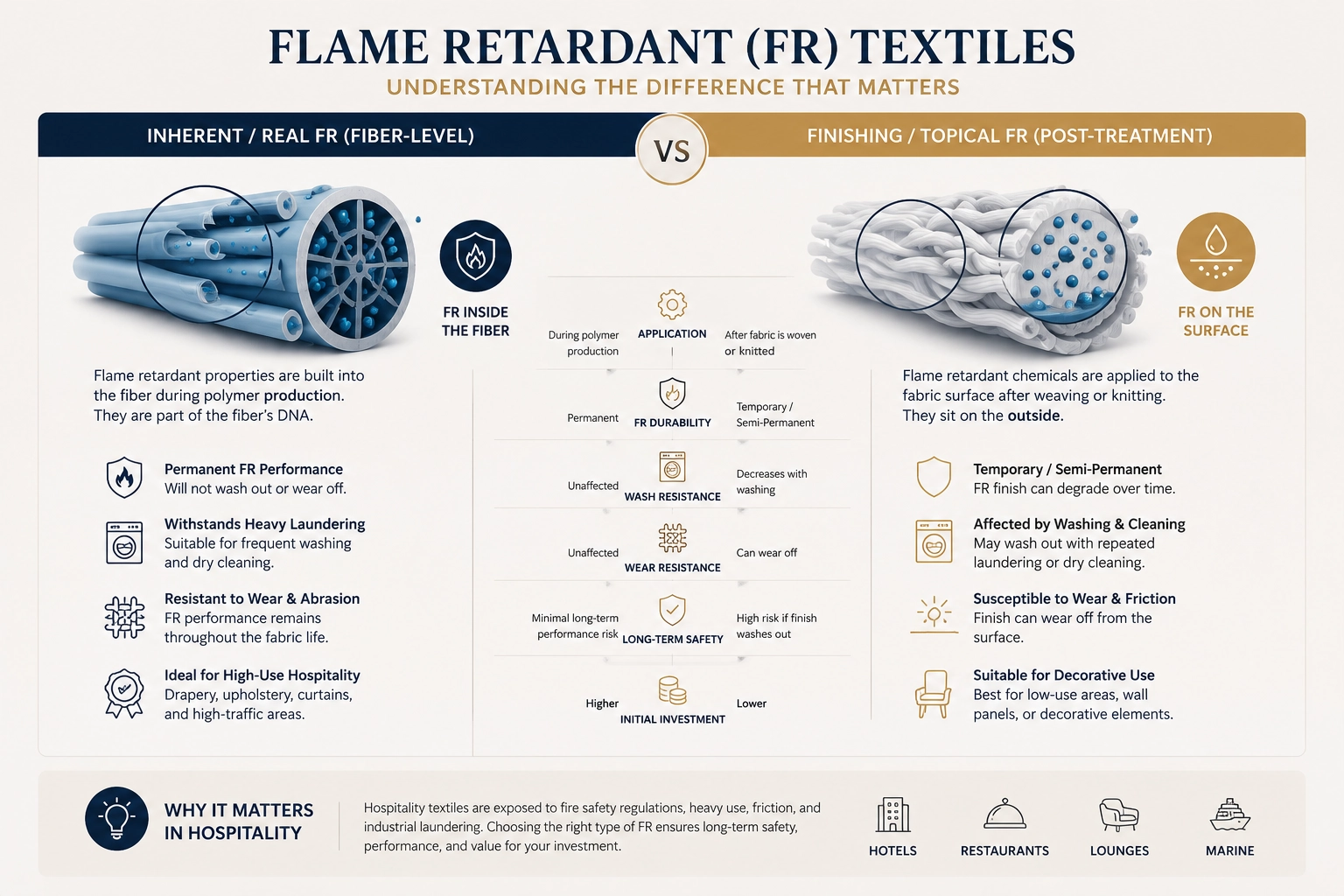
1. Inherently Flame Retardant (Intrinsic FR)
In this method, flame retardant properties are chemically integrated directly into the polymer chain or core structure of the fibre during manufacturing.
- Durability & Lifespan: Permanent. The FR property cannot be washed out, dry-cleaned or reduced through abrasion, wear or ageing.
- Mechanism: When exposed to flame, the fibre self-extinguishes or chars without spreading fire rapidly. Examples include modified polyester such as Trevira CS, modacrylic fibres and technical FR blends.
- Cost: Higher initial investment due to specialised polymer engineering and advanced yarn technologies.
- Best Applications: Ideal for luxury hospitality environments, drapery, upholstery in high-traffic areas and frequently maintained contract textiles.
2. Topical Flame Retardant (Finishing / Post-Treatment FR)
In this system, standard non-FR yarns are woven or knitted into fabric before flame retardant chemicals are applied during the finishing stage through coating, spraying or padding processes.
- Durability & Lifespan: Temporary or semi-permanent. The chemical barrier sits on the fabric surface and can gradually reduce after repeated washing, commercial laundering, abrasion or heavy use.
- Mechanism: Topical chemicals suppress or extinguish flame behaviour. However, if the finish degrades over time, the fabric may gradually lose performance.
- Cost: More economical and commonly used to upgrade standard textile constructions.
- Best Applications: Decorative textiles, lower maintenance areas or applications requiring periodic testing and re-treatment.
- Real FR vs Finishing FR
Real FR vs Finishing FR: Technical Comparison Matrix
| Feature | Inherently FR (Yarn/Fibre Level) | Topical FR (Finishing Stage) |
|---|---|---|
| Application Phase | During polymer extrusion / fibre spinning | Applied after weaving or knitting |
| Washing Resistance | Permanent performance | May decrease after repeated cleaning |
| Mechanical Wear | Unaffected by abrasion and ageing | Can gradually wear off |
| Investment Cost | Premium / Higher cost | More economical |
| Long-Term Safety | Stable long-term performance | Requires monitoring and maintenance |
Frequently Asked Questions
Does finishing FR wear off over time?
Yes. Depending on maintenance, washing cycles and abrasion, topical flame retardant finishes may gradually reduce in effectiveness.Real FR vs Finishing FR
Is inherent FR permanent?
Yes. Inherent flame retardant textiles contain FR performance at fibre level, meaning protection remains throughout the lifecycle of the fabric.Real FR vs Finishing FR
Which FR textile is better for hospitality projects?
The answer depends on intended use, maintenance frequency and specification requirements. High-traffic hospitality environments often benefit from more permanent flame retardant solutions.
For additional fire performance guidance and hospitality safety standards, review recognised technical standards from the British Standards Institution (BSI).